• Home
    • Norf'k Ilen's Language
    • Algae
    • Corals
    • Eels
    • Everything Else
    • Kingston, Norfolk Island
    • Nudibranchs, Sea Slugs and Flatworms
    • Octopuses
    • Out On A Swim Index
    • Reef Fish
    • Sharks
    • Sea Anemones
    • Sea Stars
    • Sea Urchins and Sea Cucumbers
    • Turtles
    • Underwater
    • Videos
  • Out on a swim - blog
  • About
  • Contact + Subscribe
Menu

Norfolk Island's Reef

Discover a fragile paradise – Norfolk Island's beaches, lagoons and coral reef
  • Home
  • Explore
    • Norf'k Ilen's Language
    • Algae
    • Corals
    • Eels
    • Everything Else
    • Kingston, Norfolk Island
    • Nudibranchs, Sea Slugs and Flatworms
    • Octopuses
    • Out On A Swim Index
    • Reef Fish
    • Sharks
    • Sea Anemones
    • Sea Stars
    • Sea Urchins and Sea Cucumbers
    • Turtles
    • Underwater
    • Videos
  • Out on a swim - blog
  • About
  • Contact + Subscribe

Out on A Swim

‘Out on a swim’ is a coral reef blog that tells the stories of the characters who live under the waves and what has caught my eye when ‘out on a swim’ in the lagoons of Norfolk Island. It is also a record of the difficulties Norfolk Island’s reef faces, like many others around the world, as a result of the poor water quality that has been allowed to flow onto it.

This page shows the most recent blog posts. For the complete catalogue, visit the ‘Out on a swim index’ page.

This blog is rated in the Top 20 Coral Reef Blogs in the world.

No results found
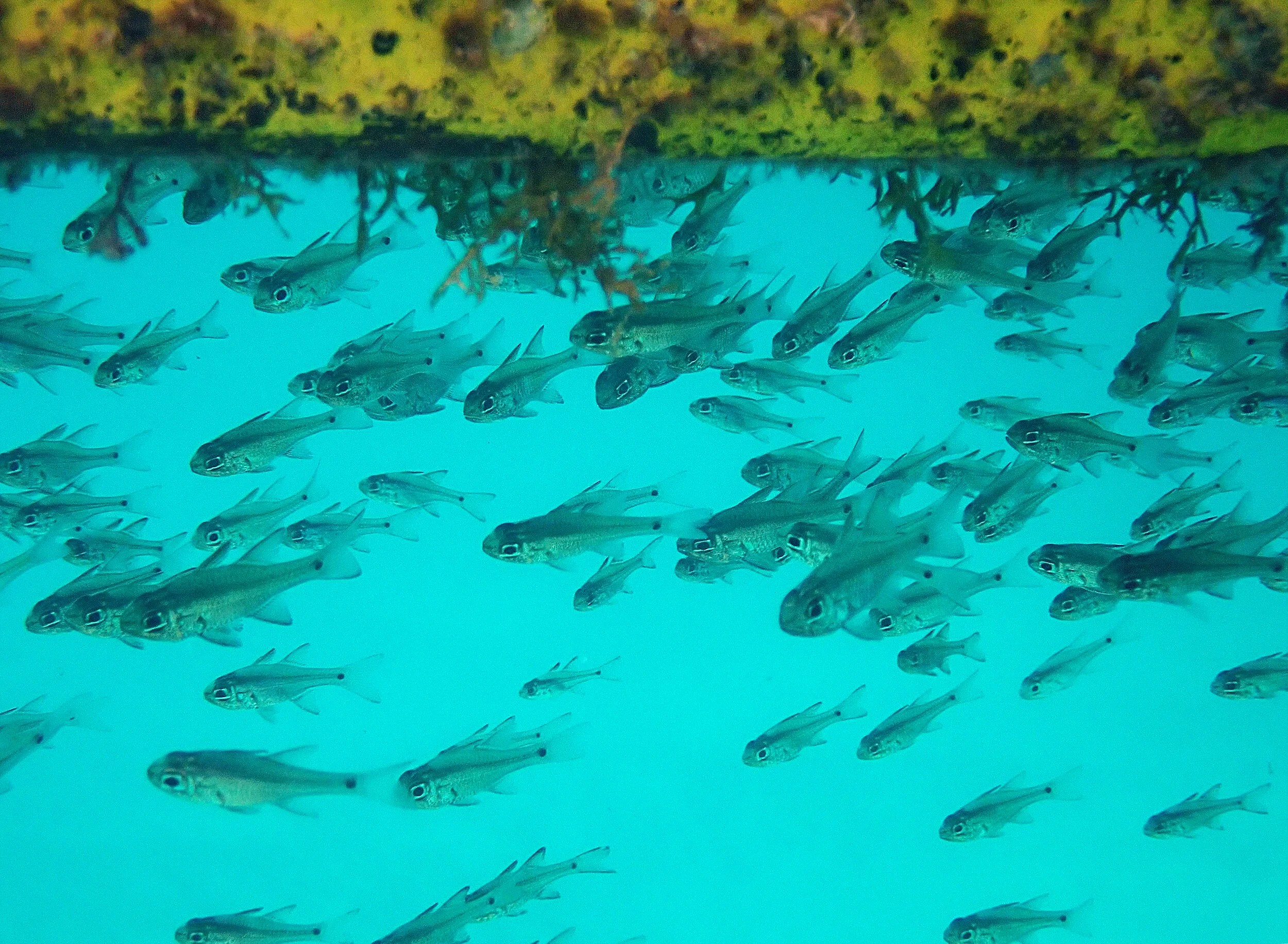
Juvenile Norfolk cardinalfish, Ostorhinchus norfolcensis, under the raft, Emily Bay

Juvenile Norfolk cardinalfish, Ostorhinchus norfolcensis, under the raft, Emily Bay

Mouth-brooding Norfolk cardinalfish

December 4, 2020

This time of the year is an interesting one for the Norfolk cardinalfish, Ostorhinchus norfolcensisas, as they are busily procreating.

Known as ‘big eyes’ on Norfolk Island, they are a quiet little fish, normally floating under ledges in schools, drifting quietly, noses into the current. These guys are mouth brooders. That is, the male nurtures the eggs in his mouth, closely guarded by the female who usually positions herself beside and just behind him. She releases the egg mass close to her male. He then takes them up in his mouth and there they stay until ready to hatch. In the photo (below) you can see his distended pouch beneath his jaw.

Every now and then he will open his mouth to aerate and rotate the eggs. It is a fleeting moment every few minutes or so. You see him extend his gills and then spit and gulp. It looks a little like he is blowing chewing gum bubbles.

While he is minding the babies, he’s unable to eat. This can be for as long as a couple of weeks. The closer he gets to releasing his babies, the more often he aerates and turns the eggs, and the more he does it, the more other fish take an interest, maybe hoping for a free meal! That is where she comes in, shooing away any potential egg stealers.

Bobbing around in a stiff current on the surface of the water in poor light, meant capturing that well on camera was beyond me; however, I was able to watch a pair for quite a while as the female shepherded and nudged him from behind.

I am looking forward to seeing all the juveniles in a few weeks.

View fullsize Norfolk cardinalfish - Ostorhinchus norfolcensis
Norfolk cardinalfish - Ostorhinchus norfolcensis
View fullsize Male, left, holding the eggs in his mouth
Male, left, holding the eggs in his mouth
View fullsize Male, aerating the eggs in his mouth
Male, aerating the eggs in his mouth
View fullsize Big eye
Big eye
Tags Norfolk cardinalfish, Mouth-brooder, Norfolk Island, Ostorhinchus norfolcensisas, Emily Bay
← Cute as a button, the Norfolk Island blennyThe elite fleet →
Featured
The Elite Fleet sails in
September 19, 2026
The Elite Fleet sails in
September 19, 2026

Nearly six years ago, my very first blog post was about the strange blue and violet creatures that live at the ocean’s surface – a group I christened Norfolk Island’s ‘Elite Fleet’. Since then I’ve seen plenty of bluebottles and the occasional violet sea snail, but never a by-the-wind sailor. Until this morning. Velella velella is not a true jellyfish, but a colonial hydrozoan with a transparent sail that lets the wind help carry it across the ocean. So what exactly is this extraordinary little creature, how does it ‘sail’, and what connects it to the rest of the fleet?

Read more →
September 19, 2026
In a nutshell – where I stand on the proposed Norfolk Island Marine Park
September 18, 2026
In a nutshell – where I stand on the proposed Norfolk Island Marine Park
September 18, 2026

I support the proposed expansion of Norfolk Marine Park and its renaming as Norfolk Island Marine Park. There is much to welcome – strong offshore protection, no mining, and recognition of the importance of sustainable local fishing. But I also have some reservations. Why does Cascade need to be removed from the Marine Park at all? How will more than 430,000 km² actually be monitored and enforced? How do we make sure Norfolk people have a genuine role in management? And, above all, how do we ensure that the enormous new park does not draw attention away from the small, stressed reef immediately beside us?

Read more →
September 18, 2026
No seagrass, but plenty of turtles
September 13, 2026
No seagrass, but plenty of turtles
September 13, 2026

Norfolk Island does not have seagrass, although one of our most conspicuous green algae is often mistaken for it. Feather and grape Caulerpa can both form striking patches across the lagoon. I take a closer look at what Caulerpa actually is, why it is so easily confused with seagrass, and where our green turtles fit into the story.

Read more →
September 13, 2026
Watching El Niño from Norfolk Island
September 6, 2026
Watching El Niño from Norfolk Island
September 6, 2026

El Niño is strengthening across the Pacific, but that does not tell us exactly what the coming months will bring to Norfolk Island. After a long wet spell, I am watching our rainfall and water supplies more closely again – and, underwater, keeping an eye on sea temperature, algae, coral recruits and the fish that turn up on the reef.

Read more →
September 6, 2026
What the world’s reefs are telling Norfolk Island
September 2, 2026
What the world’s reefs are telling Norfolk Island
September 2, 2026

Two major new coral reef reports carry a clear message for Norfolk Island: reefs can recover when pressures ease, but the time available for recovery is shrinking. Norfolk Islanders were raising concerns about water quality, runoff and the health of Emily and Slaughter Bays nearly forty years ago. Today we have much better science, a changing climate and a far clearer understanding of how closely the catchment and reef are connected. This article looks at what that means for water quality, long-term monitoring, dredging and how we manage Kingston from land to sea.

Read more →
September 2, 2026
When the map changes
August 25, 2026
When the map changes
August 25, 2026

A fish once thought to belong only to Norfolk turns up elsewhere; another appears here hundreds of kilometres beyond its known range. Cardinalfishes and a Sabre squirrelfish show how our maps of species distributions are revised.

Read more →
August 25, 2026
Endemic, native, undescribed – what do these words actually mean?
August 24, 2026
Endemic, native, undescribed – what do these words actually mean?
August 24, 2026

A Norfolk chromis that turned out not to be Chromis fumea, a blenny found nowhere else, and a tiny goby that may not yet have a name. A look at what we mean by native, endemic, undescribed and newly described – and why scientific names sometimes change.

Read more →
August 24, 2026
What’s grazing in the green stuff?
August 16, 2026
What’s grazing in the green stuff?
August 16, 2026

A proliferation of Bryopsis on the reef has brought some beautiful little underwater grazers with it. I follow the trail from sap-sucking sea slugs and egg masses to a bigger question – why is there so much Bryopsis around at the moment?

Read more →
August 16, 2026
The clam beneath Emily Bay
August 8, 2026
The clam beneath Emily Bay
August 8, 2026

I’ve seen the beautiful shells of Laciolina chloroleuca in Emily Bay for decades, but I’d never really stopped to wonder where the living animals were. It turns out they may be buried half a metre beneath the sand. A closer look at an easily overlooked clam, its extraordinary shell markings, and the hidden life beneath our lagoon.

Read more →
August 8, 2026
Reflections of an accidental marine scientist
August 1, 2026
Reflections of an accidental marine scientist
August 1, 2026

What I thought would be a steady plod towards retirement, with plenty of time spent nursing grandchildren, was abruptly upended exactly six years ago today. This is the story of how an environmental catastrophe changed the course of my life – and led me to reinvent myself. It is a reflection on how, and why, I became an accidental marine scientist.

Read more →
August 1, 2026

Latest Posts

© 2026 All rights reserved.